
Economics studies how individuals, businesses, governments, and societies allocate limited resources (such as time, money, and labor) to satisfy their needs and wants. It examines the production, distribution, and consumption of goods and services and how these activities affect the economy as a whole.
Some argue that economics is the study of choice or a social science that studies human behavior: analyzing and predicting individual behavior, developing an understanding of macroscopic trends, and interpreting their impacts.
There are two main branches of economics:
- Microeconomics: This focuses on the behavior of individual consumers, firms, and markets. It examines how supply-demand, pricing, and competition affect specific industries or products. This form focuses on individual consumption and production. Think of it as focusing on one market, not all of them.
- Macroeconomics: This looks at the economy as a whole. It studies more prominent factors like national income, inflation, unemployment, and the overall growth of an economy. It also deals with policies related to fiscal and monetary systems. This is large-scale aggregate production and consumption.
Economics or economists are concerned with understanding and explaining economic behavior and using that understanding to make informed decisions or policies. It plays a large part in politics, policy decisions, and the justification of many decisions with widespread impacts. This blog will help to contextualize some of the decisions made with information to help you, the consumer, understand how economics shapes our world.
We will start in microeconomics and examine how product and service prices are determined in individual markets.
Demand
Demand refers to how much of a product or service consumers are willing and able to purchase at different prices during a specific time period. It’s based on the relationship between price and quantity (supply) demanded.
Law of Demand: When the price of a good increases, the quantity demanded typically decreases, and when the cost of a good decreases, the quantity demanded typically increases. This happens because consumers tend to buy more of something when it’s cheaper and less when it’s more expensive.
Many factors can affect demand, including price, income, substitutes or generics, tariffs, and the general popularity of the item.
Supply
Supply refers to how much of a product or service producers are willing and able to offer for sale at different prices during a specific time period. It’s based on the relationship between price and the quantity supplied.
Law of Supply: As the price of a good increases, the quantity supplied typically increases, and when the price decreases, the amount supplied normally decreases. This is because producers are more willing to produce and sell more goods when they receive a higher price.
The same factors that can affect demand have a relationship with supply. They are two sides to the same coin.
Market Equilibrium
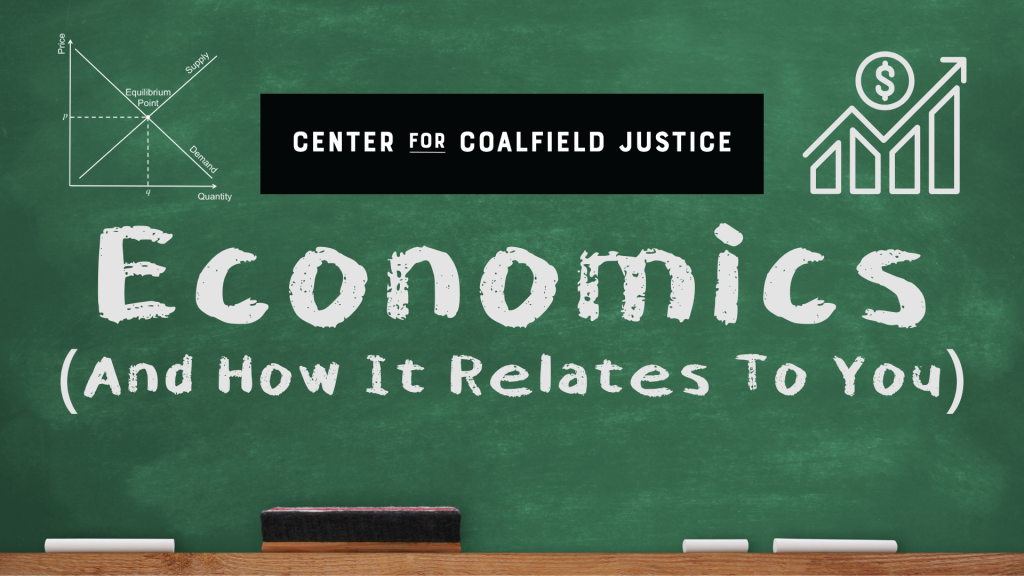
The point where supply and demand meet is called the equilibrium. At this point, the quantity demanded by consumers equals the quantity supplied by producers. The price at which this happens is called the equilibrium price, and the quantity is called the equilibrium quantity.
If the price is too high, there will be more supply than demand, leading to a surplus. If the price is too low, more demand than supply will lead to a shortage.
Market Examples
A great example of these concepts would be the price of fossil fuels in the microeconomic scope. The cost of natural gas had been at a three-year low entering quarter four of 2024. Understanding the market, gas producers like EQT and CNX reduced the production of wells and gas to decrease the supply. Our understanding of economics shows that a drop in supply will increase the demand and price for natural gas. Looking at the Independent Fiscal Office in PA, we can see that natural gas production dropped, but the price of natural gas increased by 19%. This is an excellent example of how producers can control the market to increase the cost of their product in the market artificially. These are all factors to consider when policy decisions are made to subsidize companies like these.
Let’s look at another example of economic principles in the financial discussion of establishing the liquid natural gas(LNG) export market. Toby Rice, CEO of EQT, has been quoted as saying that the US “has a duty to provide” natural gas to countries like China because they don’t have natural gas of their own. As we know, this would significantly increase the demand for natural gas and decrease the supply of natural gas for Pennsylvanians. The Department of Energy has reported on this and has determined it would increase the cost of natural gas for Americans by three times.
As these companies continue to whitewash their initiatives to increase the cost of their products, we must remember to contextualize their statements and educate ourselves on these issues. Pennsylvania and the United States will only improve with informed voters, accountable politicians, agencies, and equitable distribution of wealth and services across our beautiful country.