
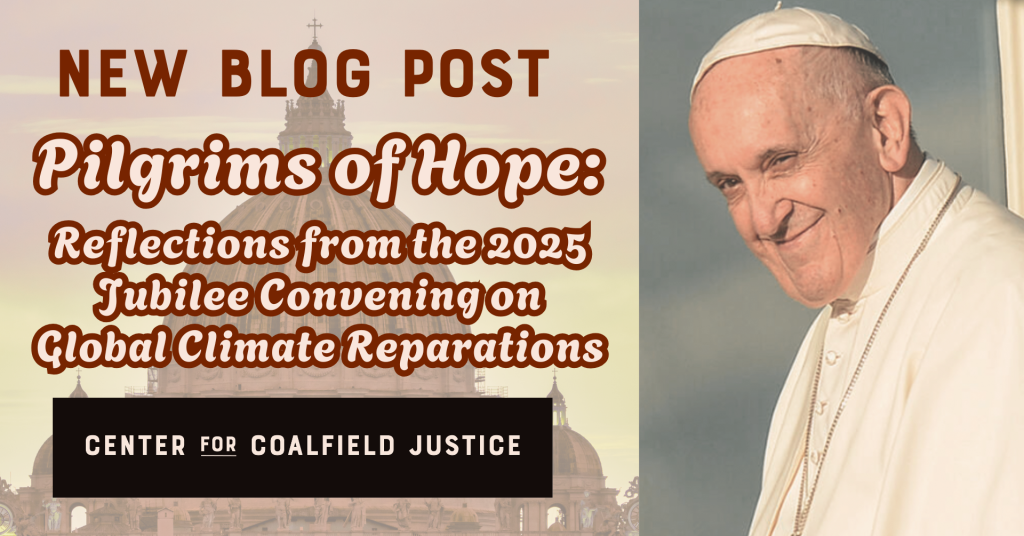
This blog was in process as we learned of the passing of Pope Francis. I am deeply saddened by his passing, and hope that the next Pope can carry forward Pope Francis’ legacy of service, unity, and compassion.
In 2015, Pope Francis published an encyclical titled Laudato Si’: On Care for Our Common Home, a plea addressing “every person living on this planet.” In it, he calls the Catholic Church and its members to focus on the environment and its destruction. Unification of Catholics geared towards global action is needed to address the climate crisis and environmental justice. As a Catholic myself, I agree, as do millions of other Catholics, people of other faiths, and nonreligious people throughout the world.
Taproot Earth invited Catholic and environmental leaders from across the globe to gather in Rome, Italy last month for a Jubilee Convening on Global Climate Reparations. Taproot Earth “envisions a world where we can all live, rest, and thrive in the places we love.” During the convening, we built relationships that span religions and the globe to advance justice and liberation to frontline communities like ours. I was blessed with representing our Washington and Greene County communities at this amazing convening. The relationships created there are invaluable. Many people across the globe are experiencing the same environmental hardships, some worse than others. The purpose of this convening was to respond to the Pope’s message to advance the care for creation, cancellation of debts, and to end extractivism. Pope Francis calls for extractive industries to end their destruction of our common home and people. “In the name of God, I ask the great extractive industries – mining, oil, forestry, real estate, agribusiness – to stop destroying forests, wetlands and mountains, to stop polluting rivers and seas, to stop poisoning food and people,” he said.

“Care for creation” acknowledges that the earth and its resources are a gift from God. We believe that we are responsible for the care of the earth, and that this Jubilee year is the time to reset, protect, respect, and care for one another, our communities, and our world. This Jubilee year is called the Pilgrimage of Hope.
For some victims of environmental pollution in our communities, all they have left is hope: Hope that the air they breathe will no longer be contaminated with methane, VOCs (volatile organic compounds), and HAPs (hazardous air pollutants). Hope that their contaminated water will become clean again. Hope that their neighbors and community will listen with compassion when they tell their stories. Hope that their children won’t get cancer from the contaminants in their community. Hope that the pain they have endured from extractive industries is grasped by their government, church, extractive industry CEOs, and their neighbors.
We have experienced and witnessed the harm of extractive industries in our communities, and it’s time for these companies, their CEOs, and our government to reset their priorities to protect and respect human life and the values of compassion, justice, and responsibility. We need to stand as a community to protect our land and the resources that God has given us, which should be respected and used in a way that benefits the communities they are extracted from.
As Catholics, we believe that water is a symbol of life and God’s grace, a sacred gift, and no other substance on earth carries this spiritual meaning. The lack of clean water dishonors the dignity of human life. There are people living in our community who do not have access to clean water due to extractive activities. It is our responsibility and duty as Catholics to restore their dignity. We must listen to their stories with compassion and understanding, meaning we must see from their hearts’ perspective. It is our moral duty.

We can help by advocating for state laws that protect our land, water, and the health of residents living near oil and gas infrastructure, starting with a 2,500-foot setback for gas wells in our state. We can support our neighbors whose water has been contaminated. In addition, Catholic business leaders must approach mineral extraction with respect, considering not only the value of the resources but also the well-being of the people living in close proximity to their facilities. It is crucial that we practice what we preach, to work to repair our relationships with those harmed, and to demand accountability from both our government and companies to protect our land and health.
It seems fitting to close with a quote from Pope Francis, who was part of the inspiration for the convening: “Our common home is being pillaged, laid waste and harmed with impunity. Cowardice in defending it is a grave sin.”
The blog is really articulated to end coal and fossil emissions. We are equally advocating for a plastic-free environment, healthy feeding and growing of traditional food to end chemical-filled food that increases chronic diseases including cancer. Well done. Sister Donata.
Thank you for reading my blog Sister Donata!