
The Clean Air Act is the law that defines the Environmental Protection Agency’s (EPA’s) responsibilities for protecting and improving the nation’s air quality and the stratospheric ozone layer. The Act calls for states and the EPA to solve multiple air pollution problems through programs based on the latest science and technology information.
However, in late March, Trump’s EPA announced that industry’s most hazardous polluters can request to sidestep Clean Air Act regulations and release unlimited amounts of toxic chemicals – including mercury, arsenic, and benzyne – into the air. In order to make this request, they can send the agency a request via email. They will be granted exemptions from pollution rules for two years, with opportunity for renewal, under Section 112 of the Clean Air Act. So far, nearly 70 coal plants have reportedly received exemptions.
This move to grant industry “Presidential exemptions” to federal pollution control is unprecedented and will have catastrophic health impacts for frontline communities and public health for years to come. In many ways, it is reminiscent of the license to pollute given to industry during one of the deadliest chapters of our region’s history.
The Trump EPA is also reconsidering the Endangerment Finding, the formal declaration issued by the organization in 2009 that greenhouse gases, primarily from burning fossil fuels, endanger public health and welfare. This finding is based on extensive scientific evidence demonstrating that greenhouse gas emissions contribute to climate change and harm human health. It serves as the legal and scientific foundation for the EPA’s ability to regulate emissions under the Clean Air Act.
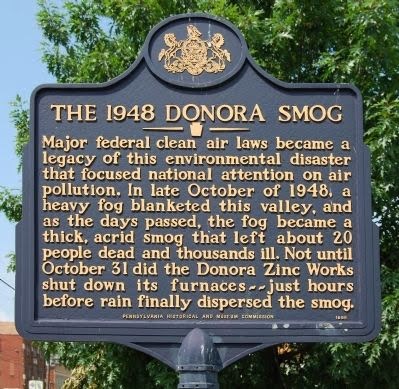
In 2023, CCJ partnered with the Donora Historical Society and Smog Museum and others for a webinar to commemorate the 75th anniversary of the Donora smog, an event that jumpstarted the fields of environmental and public health and led to the creation of the Clean Air Act. The deadly smog of 1948, caused by air pollution from the Donora Zinc Works, was one of the worst air pollution disasters in U.S. history. Emissions from the plant killed 21 people and caused health issues for thousands more in the town of Donora and the surrounding Monongahela Valley in southwestern Pennsylvania.
During the webinar, the Donora Historical Society and Smog Museum gave a presentation about the Donora Smog, the community of Donora, and the disaster’s lasting impact on environmental and public health policy. The presentation was followed by a roundtable discussion with representatives from the Center for Coalfield Justice, The Descendants Project, and Breathe Free Detroit about their work and their reflections on the Clean Air Act. Our partners at Halt the Harm Network helped to facilitate and record the event.
Recently, we asked Brian Charlton, a historian and former school teacher who is the Donora Smog Museum’s archivist and curator, about his reaction to threats to the Clean Air Act. This is what he said:
“There is just so much to say about the unprecedented times in which the United States finds itself. Any meaningful gains in environmental protection have been through the efforts of bipartisan legislation and the simple burden of doing the right thing. The foundation of that cooperation, the sense of right and wrong, give and take, has been rendered moot by the current administration.
We no longer have a separation of federal powers; the legislative and judicial branches have willingly succumbed to an authoritarian executive. This administration doesn’t care who the victims are, as long as they aren’t in the top one percent. All of this didn’t start on Inauguration Day 2025. It has been years in the making. As a historian, I look at a forty-plus-years’ process of misinformation, hate, and fear all carefully nurtured to destroy trust and cooperation in the government and education.
People want instant answers to complex problems. They don’t like, appreciate or trust educated people. They want catch phrases, and an enemy to blame for their situation. In Donora in 1948, hardly a person in town didn’t realize that the pollution coming out of the Zinc Works was bad for the environment and bad for their health. Yet they said and did nothing to address the issues, because the Zinc Works provided good-paying jobs, something that Americans have valued above all else. Justice, freedom, democracy, religion: those people then and the people of today would trade it all for a good paying job. If the environment stands in the way of that “value,” then we’ll gladly and willingly sacrifice the environment for it.”
Although people “said and did nothing about the issues,” as Brian describes, they organized afterwards to make change, and this became part of the impetus for the Clean Air Act. Now that we know more about what is at stake, we need to make critical policy decisions before more negative consequences happen. In other words, our policy needs to be forward-thinking: It should prevent harm when it can, and it should be rooted in what people need to succeed and to live their lives in the healthiest way possible.
Brian touches on issues that are prevalent in the U.S. One is that people often want easy and fast answers to complex problems, catch phrases to use in place of explanation and understanding, and an enemy to blame for a situation. Nuance and context are often disregarded as unimportant or irrelevant, though they are crucial to both having a real understanding of an issue and working to diagnose, improve, and solve problems. When pundits give us someone to scapegoat, this not only serves to divide us and pit us against one another, but also keeps us from learning the realities of a situation and working toward a solution. Last, we strongly believe that both education and experience are important to understanding and addressing problems. Lived experiences should not count less than hard data, science, or education, but at the same time, opinions can’t only be limited to what people think they know. We want to encourage people to be curious, to question whether what they think or have heard is true or accurate, and to recognize that something that is true for one person might not be true for someone else, and that’s okay! These are trying times we’re living in, and we need to stay curious and open to new knowledge.
In closing, please consider donating to our webinar partners. In particular, the Donora Historical Society and Smog Museum can use your support in order to preserve, research, and promote Donora’s history as well as the smog’s impact on environmental concerns and issues. To donate, please use their PayPal link located at the bottom of their main webpage. If you would like to add a note along with your donation, or would like to donate another way, email donorahistoricalsociety@gmail.com.
Further reading:
The Deadly Donora Smog of 1948 Spurred Environmental Protection—But Have We Forgotten the Lesson?
The Clean Air Act 101
The Donora Smog Revisited: 70 Years After the Event That Inspired the Clean Air Act
After 75 years, ‘willful ignorance’ remains the Donora Smog’s lasting fallout
Donora Death Fog : Clean Air and the Tragedy of a Pennsylvania Mill Town
When Smoke Ran Like Water: Tales of Environmental Deception and the Battle Against Pollution