
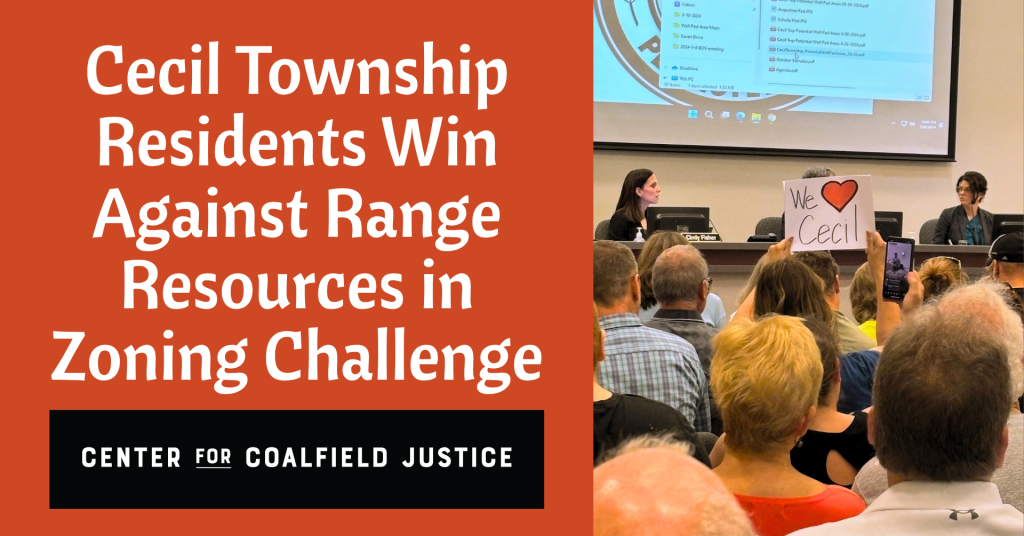
For years, residents of Cecil Township have been asking their elected officials for more extensive protections concerning oil and gas development in their community. After several revisions and years of debate, the Cecil Township Board of Supervisors answered their call. On November 4, 2024, the Cecil Board of Supervisors voted on and approved Ordinance No. 09-2024. Ordinance No. 09-2024, among other items, created a setback provision that prohibited the development of any new oil and gas well pads within 2,500 feet of any home, unless waived by the landowner. It also created a 5,000 ft setback from any school or hospital within the township. This balances safety with flexibility, aiming to protect public health without banning development.
Shortly thereafter, on December 27, 2024, Range Resources Appalachia, LLC (“Range”) filed a substantive challenge to the validity of the Townships ordinance before the Townships Zoning Hearing Board (“ZHB”). Range argued that Ordinance No. 09-2024 unlawfully restricts oil and gas development. A coalition of residents, environmental advocates, and civic organizations—including the Center for Coalfield Justice —stepped up to defend the ordinance and the community’s right to protect its health, safety, and environment. Shortly after Ordinance No. 09-2024 was voted upon, it was modified by Ordinance No. 05-2025 (“Ordinance”).
Range Resources claims these setbacks effectively prevent them from developing gas in the township, which is legally known as a “de facto exclusion.” However, the company admits it has no current plans or permits for new wells in Cecil Township. In fact, all of Range’s five active well pads in the township were approved before the Ordinance and are unaffected by it. Since the Ordinance was enacted in November of 2024, Range had not applied for any new operating permits with either the Township or the Department of Environmental Protection. Therefore, since Range had not taken any steps to show it intended to further develop in the Township, it had not suffered any harm. Meaning that it was business as usual for Range as the Ordinance was for only new oil and gas development, not existing gas wells.
After three public hearings, Range laid out several arguments and witnesses trying to convince the ZHB how its interests were being harmed by the Township. Yet, it was not sufficient to persuade them. On June 16, 2025, the Cecil ZHB ruled to dismiss Range’s challenge as they did not show that the Ordinance harmed them. The ZHB continued to share that not only did Range not experience any harm from this Ordinance, but since Range had not exercised the new Ordinance (applying for a permit), there was no case to be heard in the first place. Therefore, the ZHB dismissed Range’s challenge.
This issue matters for communities where oil and gas development is a common practice. This isn’t just a technical land-use dispute. It’s about whether a community can set reasonable boundaries on industrial activity to protect its people and whether the oil and gas industry can use its influence and legal power to undermine local decisions made through democratic processes. This decision shows how important it is for a community to have the right to govern land use, prioritize public health, and plan for a sustainable future.
This case is about Cecil Township. It is also about empowering communities everywhere. Local governments must be able to protect their residents from the known harms of industrial development, particularly when those harms affect air, water, and long-term health.
CCJ stands with Cecil Township and all communities that fight for their right to breathe clean air, drink clean water, and live free from industrial intrusion. Local democracy matters. And it’s worth defending.