
This is the 12th blog in our Examining Climate series, where CCJ staff members and others will be sharing their favorite (or least favorite) climate solution, looking at the benefits and the costs in the hope of sparking an honest conversation about how we address the climate crisis and keep our focus on environmental justice. This blog was written by CCJ Legal Fellow Seth Sherman.
When monitoring the practices of the fracking industry, we at the Center for Coalfield Justice try to be proactive in preventing community impacts from its continued development. The industry has an ever-growing wastewater problem that has presented operators and communities substantial logistical, ecological, and human health problems with no safe viable solutions. The current industry and regulatory standard for disposing of fracking wastewater is the use of injection wells.
Fracking wastewater is a massive problem for the fracking industry for two reasons: the quantity of it that is being generated, and how dangerous it is to human and ecological health. Each fracking well will generate at least 15 million gallons of wastewater during its operation, and with up to a dozen wells per well pad, hundreds of millions of gallons of this wastewater is being generated annually across the state. This wastewater is extremely dangerous, as the alkaline nature of it allows it to extract radioactive heavy metals from the bedrock it fractures. Many of its additives are known carcinogens including PFAS and other ‘forever chemicals’. While the science supporting the dangers of this wastewater is substantial, both state and federal regulations do not reflect this reality. As such, industry has been allowed to dictate the means by which it disposes of this wastewater.
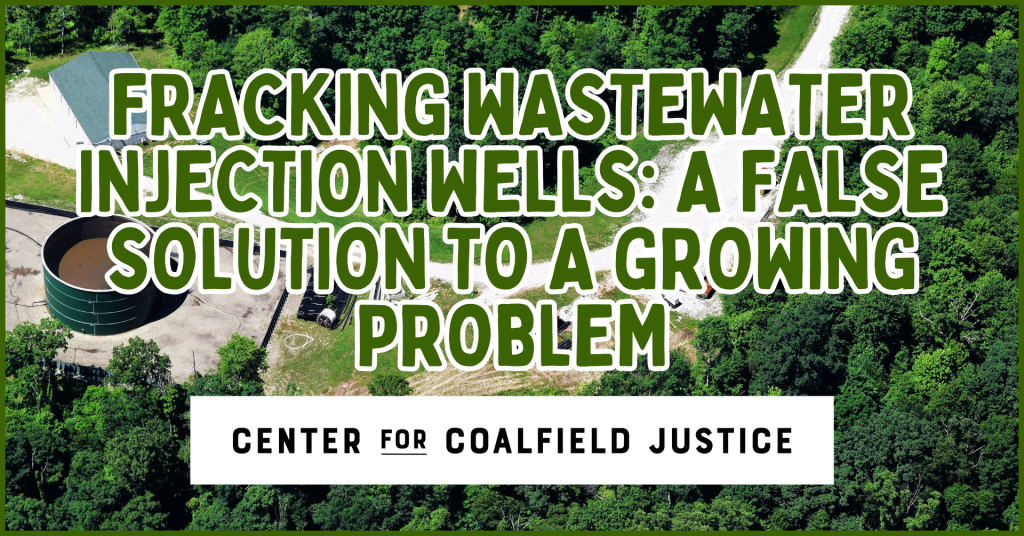
Injection wells are the industry’s current false solution to its wastewater problem. A fracking wastewater injection well is exactly what it seems: a hole bored underground where pressurized wastewater is sent deep into the earth to be “contained.” In theory, if the well goes into stable geology far below groundwater level, the water will be safe there. However, many of the communities in which these injection wells currently operate have faced substantial problems, the extent of which is currently unknown.
Similar to that of the fracked gas produced by the fracking industry in PA, the wastewater from fracking is largely exported. A majority of the injection wells that take in PA’s fracking wastewater are in eastern Ohio. The communities which surround these facilities have experienced a major uptick in seismic activity and dozens of communications with conventional oil wells and drinking water wells. While such incidents have been reported in the region as early as 2019, the current scale and scope of the contamination from these injection wells is unknown. Similar to the experiences of the people of New Freeport, community members in Washington County, Ohio gave testimony about their experiences with total loss of oil from conventional wells and slimy, foul-smelling substances in their well water.
This similarity is precisely why CCJ and our communities in Washington and Greene Counties must stay vigilant to the inevitable expansion of the industry’s current wastewater solution. The fracking industry was able to take advantage of the relaxed regulatory approach Ohio took to the development and operation of these wells. This allowed for the construction of over 200 wells there, compared to 16 in PA. While there are currently no injection wells in our service area, you do not have to go far to find one.
Plum, a small community just east of Pittsburgh, has had a fracking wastewater injection well operating there since 2017. Multiple community members supported by Protect PT, a coalition organization for CCJ, have reported substantial air quality and water infiltration issues from the facility. Community organizing in consideration of those issues led Plum’s Zoning Heard Board to unanimously deny Penneco’s, the facility’s operator, application for variance to build a 2nd facility there just a few months ago.
The fracking industry has completely failed to come up with safe and viable solutions to its ever-growing wastewater problem. For years industry misled regulators and the public about the ecological and human health effects of its wastewater. So much so that wastewater was being used as a road-spreading agent for dust suppression and deicing across the roadways of the state for years. Then when that practice was banned in PA, industry shipped the wastewater off to be spread on the roads of Ohio. And with the uncertain legal status of road-spreading across both states, industry will be looking to expand its networks of injection wells.
The current regulatory framework in which fracking wastewater is handled has allowed the industry to largely dictate how it handles this waste. Industry has yet to develop a safe and viable disposal method for its wastewater. The experiences of the communities of SE Ohio and Plum don’t just illustrate why these injection well facilities are problematic; they create a model of what the communities of Washington and Greene Counties can soon expect. This wastewater has to go somewhere. As the communities near existing wells sour to their presence and prevent their expansion, the fracking industry will be forced to look elsewhere to dispose of their hundreds of millions of gallons of hazardous waste. We must stay vigilant of this industry practice and be ready when they attempt to bring it here. The industry will misrepresent the risks involved, provide false hope of safety and job creation, and we will be ready to respond.