
Two weeks ago, new economic numbers were released that normally would signal good news for the economy: productivity is rising.
Productivity measures how much the economy produces per hour of work. When productivity increases, it usually means workers and businesses can produce more value in the same amount of time. This is usually thanks to better technology, improved tools, or more efficient systems.
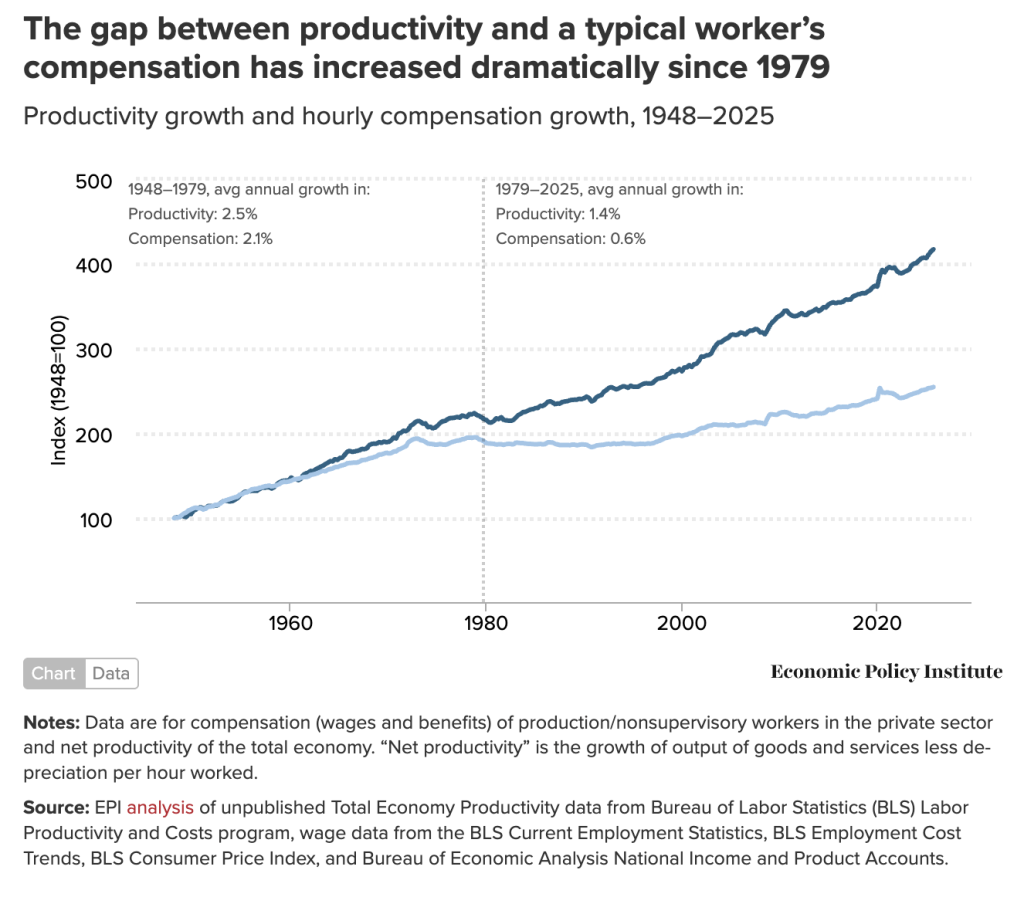
Historically, that has been good news for workers. For much of the mid-20th century, productivity growth translated into higher wages and broader prosperity. From the late 1940s through the early 1970s, productivity and worker compensation rose together. Reports by the U.S. Bureau of Labor Statistics, analyzed by the Economic Policy Institute, show that during this period, productivity gains were roughly parallel to wage growth for the average worker. However, recent data suggest that the connection is weakening.
According to the latest report from the U.S. Bureau of Labor Statistics, nonfarm business productivity grew by 5.2% in the third quarter and 2.8% in the fourth quarter, both stronger than the long-term average productivity growth rate of about 2.2%. On its face, that suggests an economy becoming more efficient and productive. However, a closer look reveals a troubling trend.
The share of economic output going to workers has fallen to roughly 53.8%, the lowest level recorded since this measure began in 1947. Economists call this the labor share of income, or the portion of the economy’s output paid to workers as wages and benefits rather than going to corporate profits or shareholders. Research from the International Monetary Fund and the Federal Reserve Board has reported a long-term decline in labor’s share of national income across advanced economies. What does this mean? When productivity rises, but the labor share falls, it means workers are producing more output without receiving a proportional share. In other words, the economy is growing, but the gains are not being shared evenly.
This divide is seen in everyday financial realities. For instance, retirement savings accounts appear strong. Look at the Fidelity Investments report showing that average 401(k) balances recently reached record highs.1 But at the same time, Fidelity also reported record levels of hardship withdrawals. Translating this shows that more workers are tapping into retirement savings accounts early to pay for urgent expenses like medical or housing costs.2
These two trends reflect what economists are calling a “K-shaped economy” (see the below graph). Households with a higher income or significant investments see their wealth grow. Meanwhile, many working families are struggling with rising costs and increasing debt. To add insult to injury, it is believed this divide could widen even more in the years to come.
The rapid expansion of artificial intelligence and large-scale data infrastructure is likely to drive another wave of productivity growth. Research from McKinsey Global Institute estimates that emergent AI alone could add as much as $4.4 trillion annually in global economic value. Yet, economists have also warned that automation and AI may disproportionately benefit shareholders and highly skilled workers while displacing or restructuring other jobs.
Those technologies depend on enormous computing power, which is why the United States and Pennsylvania specifically are seeing a surge in data center proposals. According to projections from the International Energy Agency, power demand from data centers could more than quadruple globally by the end of the decade.
Even though these data centers generate significant profits and productivity gains, they currently offer relatively few permanent jobs once the facility is built.
Taken together, these trends raise an important question for policymakers and communities alike. If new technologies like AI dramatically increase productivity but the gains flow primarily to investors, tech firms, and infrastructure owners, the same economic pattern we see today could intensify. The productivity numbers themselves are not the problem. A more productive economy should create more wealth and opportunity.
The real issue is whether the benefits of that growth are reaching the people who help create it.
An economy in which technology and automation make everything more productive, but workers fall further behind, is simply not an economic challenge. It is a question about what kind of economy we want to build in the first place.
- Almazora, Leo, Vanguard, Fidelity Data Show New Record Highs in 401(k) Savings, Investment News, Retirement Planning, March 4, 2026, showing 2025 Q4 at there were 665,000 millionaires, up from 654,000 in the previous quarter. Also in the same report, 2025 Q4 balances increased 11% from the prior year quarter. ↩︎
- Id., reporting that 6% of their clients made hardship withdrawals in 2026, compared to 4.8% in 2024, and around 2% before the pandemic. ↩︎