
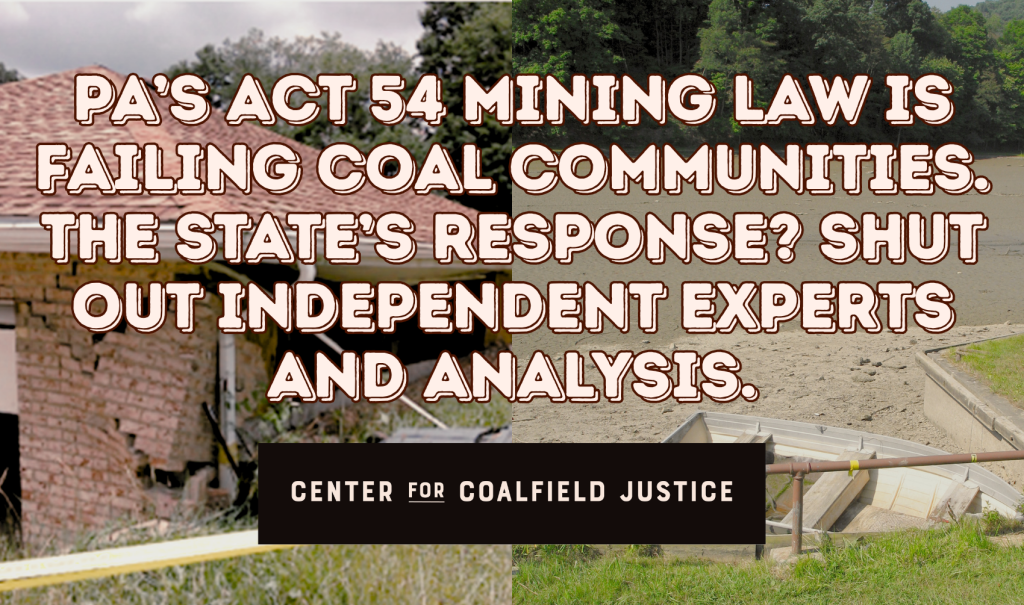
In early 2025, the PA Department of Environmental Protection (PADEP) released its 6th assessment of ACT 54. ACT 54 is a state mining law that allows a coal company to legally extract coal while also requiring the company to repair surface damage to homes, water sources, and more. Under ACT 54, the PADEP was tasked with publishing a report every five years that reviews the impacts underground coal mining has had on structures, land, streams, and drinking water supplies. The reports have provided the state, policymakers, and the public with details on how the coal mining industry has fulfilled the promises made by ACT 54.
The first assessment, released in 1999, was conducted internally by the PADEP and faced significant criticism for lacking objectivity, thoroughness, and overall credibility. Consequently, outside researchers were included in subsequent assessments. For instance, the 5th assessment involved 19 researchers from the Carnegie Museum of Natural History and the University of Pittsburgh. Concerningly, the most recent 6th assessment was once again conducted internally by the PADEP. And, much like the first assessment, this internal assessment falls short of the careful, objective analysis that communities living near coal mining deserve.
In response, the Citizens Coal Council (CCC) has published their Review and Analysis of the PADEP’s 6th Act 54 Report. It strongly criticizes the 6th assessment, exposing many errors and inaccuracies. The analysis reveals the lack of expertise and professionalism demonstrated by the report’s authors, resulting in an absence of meaningful analysis. Furthermore, they note that the authors of the 6th Assessment are not even listed, there is no publication date, and a resource list is missing despite citations throughout the document. Please read CCC’s analysis for a deeper understanding and for some actual analysis of mining in PA during the 6th assessment period. CCC has also provided a policy report, which outlines their recommendations to improve Act 54 reporting.
Local legislators, who receive funding and campaign contributions from coal companies, cited rising costs of producing the report and a burden on taxpayers as reasons for a legislative reversal to an internal assessment (namely, State Senator Camera Bartolotta, who authored the legislative changes) (https://www.palegis.us/legislation/bills/2019/sb763). Meanwhile, these same politicians conveniently turn a blind eye when coal companies burden taxpayers daily by damaging highways, roads, homes, water sources, property values, and utilities. And to boot, the legislators have put the onus and extra work on the DEP, which is already understaffed and over-worked.

The lingering question is: What are the reasons the coal companies and their puppet legislators felt the need to blow this process up? It’s simple, but unfortunate for PA residents: ACT 54 isn’t working as intended. ACT 54 was designed to be an easy way for homeowners to repair or replace their property if they experienced damage during the mining process. However, (as shown in Table 4 above) the vast majority of homeowners who experienced mine-related damages from 2018-2022 either entered into a private agreement (68%) or sold their property (16%). Alarmingly, very few mine-related damage claims resulted in official repair (7%). Only 4 structures (i.e., dwellings, outbuildings, garages) were officially repaired in the 6th assessment window of 2018-2022. FOUR!!
Private agreements and property sales to coal companies can have significant negative consequences for the community. When a company purchases a property, it is no longer obligated to repair damage or replace water sources. Nor are they required to report damage! (Why would they tell on themselves?) Sadly, when the company purchases a property, they often demolish existing structures to lower property taxes, not only displacing residents but also decreasing the tax revenue available to fund critical local services. While a private settlement may provide funds for a homeowner to fix damage, there is no requirement to do so, and an unrepaired home loses value. Lest we mention, the potential loss or damage to personal water sources (i.e., wells and springs), streams, wetlands, or ponds can also result in diminished property values. While Act 54 requires permanent water replacement, a settlement reached with an individual homeowner is not necessarily binding on future property owners. Consequently, if that homeowner can manage to sell the property, the new owner could not be covered by the agreement and may be responsible for supplying their own water source. This certainly will negatively impact resale value.
Another factor obscuring proper research and analysis is the deceptive, predatory ‘Keep DEP Out’ pre-mining agreement that some homeowners may sign. These agreements may transfer the coal operators’ obligations from a statutory (Act 54) to a contractual basis. Nearly every landowner that has been longwall undermined in the past decade has reported to have seen this option when negotiating with a coal company. This language lives in legal contracts that CCJ is not allowed to review, so we don’t have any examples to show. Unfortunately, this shady tactic remains shaded by a lack of reporting. Furthermore, in this case, the coal company has near-total control over whether any mining-related damages are reported to the DEP. (Again, why would they tell on themselves?)
Additionally, because of this type of agreement, the company has firm control over damage repair settlement negotiations that occur when damage from mining occurs. If the homeowner has an issue with the company’s repair offer but has signed away their ability to speak with DEP, who can they speak with? Unless they have the means for a costly legal battle, homeowners facing costly repairs are left at the whim of the coal company, with few options for support.
Now, imagine having all the Act 54 data and a fair third-party analysis. Do you think that our legislators could so easily turn a blind eye to all the harms our community faces because of predatory and deceptive business practices? Our legislators must start to choose people over profit.
The Citizens Advisory Council to the PADEP is currently accepting public comments on the latest assessment of the underground mining laws. PADEP must exercise its authority to improve the mining program and protect residents’ property and access to clean water. Our communities cannot afford to have only four structures officially repaired in four years. If you would like help drafting a comment, please feel free to reach out to us at info@centerforcoalfieldjustice.org.