

OVERVIEW
The development of OxyContin, along with the massive proliferation of opioid usage that followed, remains today one of the greatest struggles in many areas of the United States. People suffer, families are fractured, and communities remain injured by the onslaught of addiction. When folks hear the term “opioid crisis,” nearly everyone can picture either themselves, or someone they know, affected by the devastating impact of these drugs.
Due to extreme overprescription, woeful provider/manufacturer negligence, and eventual rise of street drug variants, a public health crisis was created. Drug companies were aware of the dangers posed by the opioids they developed, and complicit in the targeting of vulnerable populations for distribution. Appalachia was a primary target for drug companies, as labor-related injuries and economic struggle left many community members vulnerable and desperate for relief. The companies preying on the region mocked folks suffering in Appalachia as “pillbillies”.1
In recognition that someone needed to be held responsible for the destruction caused by the opioid use epidemic, many attorneys general–including Josh Shapiro–came together to seek a form of compensation. The lawsuit resulted in settlements won against drug manufacturers, distributors, and pharmacies such as Johnson & Johnson, McKesson, and even Walmart. These settlements became what we know as the Opioid Settlement Fund. With an initial pot of between $1.5 billion 2 – $2 billion 3 (to be distributed through 2040), Pennsylvania now has the funds to begin to more adequately mitigate the individual and community harms of the opioid crisis. Recently, Purdue Pharma and the Sackler family–the creators of OxyContin–were one of the final responsible entities to settle in court, which is estimated to add an additional $200 million 4 to PA’s settlement fund total. Of the total Pennsylvania settlement fund allotment: 70% is distributed directly to counties, 15% goes to the Pennsylvania Department of Drug and Alcohol Programs, and the final 15% goes to certain district attorney offices and municipalities with special involvement in the opioid fund litigation process.5
The Process
Washington and Greene Counties have already received initial disbursements from the settlement and are actively spending the funds on projects. County allocations 6 were determined based on total number of opioid deaths, Opioid Use Disorder-related hospitalizations, Emergency Medical Service naloxone administrations, and the amount of opioid prescriptions dispensed from 2006-2014. Using an equation based on these factors, it was determined that Washington receives 1.674% and Greene receives .205% of the total money awarded directly to counties. Over the course of the disbursement timeline, Washington County is projected to receive between $17,577,000 and $23,436,000 and Greene County will receive between $2,152,500 and $2,870,000. These estimates were established using the PA Opioid Settlement Data website 2 and Christine Minhee, J.D. ‘s Opioid Settlement Tracker 3 combined with the annual Opioid Trust Commonwealth Court Report 6.
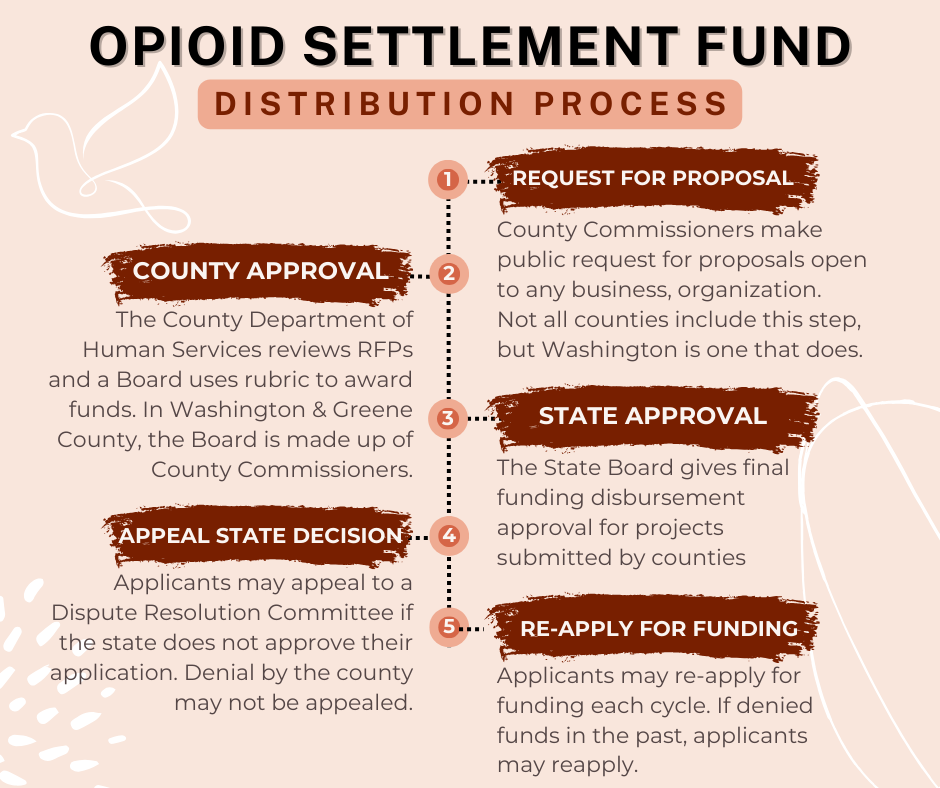
Overseeing this process is the PA Opioid Misuse and Addiction Abatement Trust 7. The funds managed by the county commissioners are very important for local mitigation and treatment efforts. Money is awarded to local government, non-profit organizations, businesses, and treatment providers based on the following process:
When determining awardees, commissioners are supposed to consult the document “Exhibit E.” Exhibit E describes opioid crisis remediation efforts that should be funded by the settlement fund, and was included as part of the final Distributor Settlement Agreement that legally created the fund.
Awardees so Far
As of this writing, Washington County Commissioners have awarded nearly $5.5 million 9,10,11 and Greene has awarded about $175,000 12.
- Larger recipients (>$100,000) in Washington include: Gateway Rehab, Harmony Life Center, Serenity Farms, Focus MD, Department of Human Services, Resurrection Power, and most recently, the Shawn Patrick Recovery House.
- Smaller recipients (<$100,000) in Washington include: Domestic Violence Services of SWPA, SPHS Care Center, Avella Wellness Center, Turning Point Washington, Blueprints, Lemoyne Community Center, police social workers, and the D.A.R.E Program.
- However, some applicants have been denied funding, including the Washington County Drug & Alcohol Commission, Hope Works, and the Johnson-Shaw Foundation, among others. Knowledge of which applications did not receive funding were obtained via a “Right to Know” request submitted to Washington County.
- Greene County has only funded one project–the Gaiser Center 12, which seeks to expand programs spanning the entire treatment and recovery process.
A complete list of awardees can be found at the links provided under the “Resources” section at the end of this blog.
According to the most recent report12 released by the Opioid Misuse and Addiction Abatement Trust, all applications from Washington and Greene that the trust has received through 2024 have been approved.
Concerns and Conclusions
National and statewide concerns have been raised over perceived improper usage of settlement fund money. The Opioid Policy Institute created a website13 to collect reports of waste, fraud, abuse, and mismanagement. This website hosts a public database where anyone can view the compiled complaints from around the country or submit their own. Common complaints include: lack of transparency on why awardees are chosen, lack of coordination between services, programs not proving alignment with “Exhibit E” protocols, and lack of formal accountability for misuse of opioid settlement funds.
The Opioid Settlement Fund is Pennsylvania’s big opportunity to rectify at least some of the harm brought by the opioid crisis. Victims of Substance Use Disorder (SUD) and their families have suffered long enough. As the perpetrators of the opioid epidemic are finally being made to atone for their actions, it is vital that those who control the settlement fund money maximize the effectiveness of every dollar. Community members who have seen first-hand the need for substance use treatment resources, like many of you reading this, must stay vigilant to ensure the money is used effectively.
Resources
| If you are seeking assistance with substance use disorder, you can contact: | – Washington Drug and Alcohol Commission: 724-223-1181 – Greene County Drug and Alcohol Program: 724-852-5368 |
| Links regarding funded programs in Washington County | – Washington County Department of Human Services Opioid Settlement 2024 Wrap Up – Observer-Reporter Article 1 – Observer-Reporter Article 2 |
Sources
- McGreal, Chris. “Big Pharma Executives Mocked ‘pillbillies’ in Emails, West Virginia Opioid Trial Hears.” The Guardian, Guardian News and Media, 16 May 2021, www.theguardian.com/us-news/2021/may/16/amerisourcebergen-pillbillies-emails-west-virginia-opioid-trial-.
- “About the Settlements.” PA Opioid Settlement Data, Pennsylvania Opioid Settlement Data, www.paopioidsettlementdata.org/methods/.
- Minhee, Christine. “Global Settlement Tracker.” Opioid Settlement Tracker, Christine Minhee, OpioidSettlementTracker.com, www.opioidsettlementtracker.com/globalsettlementtracker/#sums. Accessed 28 Aug. 2025.
- “Purdue Pharma Estimated Distribution Chart .” National Opioids Settlement, nationalopioidsettlement.com/wp-content/uploads/2025/06/Estimated-Distribution-Chart-from-Disclosure-Statement-for-13th-Amended-Joint-Chapter-11-Plan-filed-6.17.2025.pdf. Accessed 18 Aug. 2025.
- “Pennsylvania’s Opioid Settlements.” Opioid Settlement Guide, Vital Strategies/opioidsettlementtracker.com , www.opioidsettlementguides.com/pennsylvania. Accessed 28 Aug. 2025.
- SECOND ANNUAL REPORT OF THE PENNSYLVANIA OPIOID MISUSE AND ADDICTION ABATEMENT TRUST PURSUANT TO PARAGRAPH VI(A)(6) OF THE ORDER ENTERED JULY 12, 2022. As ordered by (Commonwealth of Pennsylvania v. Amerisourcebergen et. all; 244 MD 2022) & (Commonwealth of Pennsylvania v. Johnson & Johnson et. all; 243 MD 2022).
- “About the Pa Opioid Misuse and Addiction Abatement Trust.” Https://www.Paopioidtrust.Org, www.paopioidtrust.org/about-us. Accessed 28 Aug. 2025.
- Exhibit E: List of Opioid Remediation Uses. As created by the Final Distributor Settlement Agreement, 11 Aug. 2021.
- “Opioid Settlement 2024 Wrap-Up.” Washington County Human Services , Washington County Department of Human Services , www.washingtoncountyhumanservices.com/uploads/pages/Opioid%20Settlement%202024%20%20Wrap%20Up-1736521815653.pdf.
- Jones, Mike. “Washington County Allocates $2.69 Million in Second Round of Opioid Settlement Funds.” Observer-Reporter, 7 Mar. 2025, https://www.observer-reporter.com/news/local-news/2025/mar/07/washington-county-allocates-2-69-million-in-second-round-of-opioid-settlement-funds/. Accessed 2025.
- Jones, Mike. “Washington County Disburses Third Round of Opioid Settlement Funds.” Observer-Reporter, 18 July 2025, https://www.observer-reporter.com/news/local-news/2025/jul/18/washington-county-disburses-third-round-of-opioid-settlement-funds/. Accessed 28 Aug.2025.
- “Pennsylvania Opioid Misuse and Addiction Abatement Trust Remediation Program Determinations.” PA Opioid Trust, 21 Aug. 2025, www.paopioidtrust.org/getmedia/d9e0e076-f0c2-4839-9cc6-593de9db13e5/20250821-Remediation-Program-Determinations.pdf.
- “Opioid Settlement Money Accountability.” Edited by Johnathan JK Stoltman, Opioid Policy, Opioid Policy Institute, opioidpolicy.org/osm-accountability. Accessed 28 Aug. 2025.