
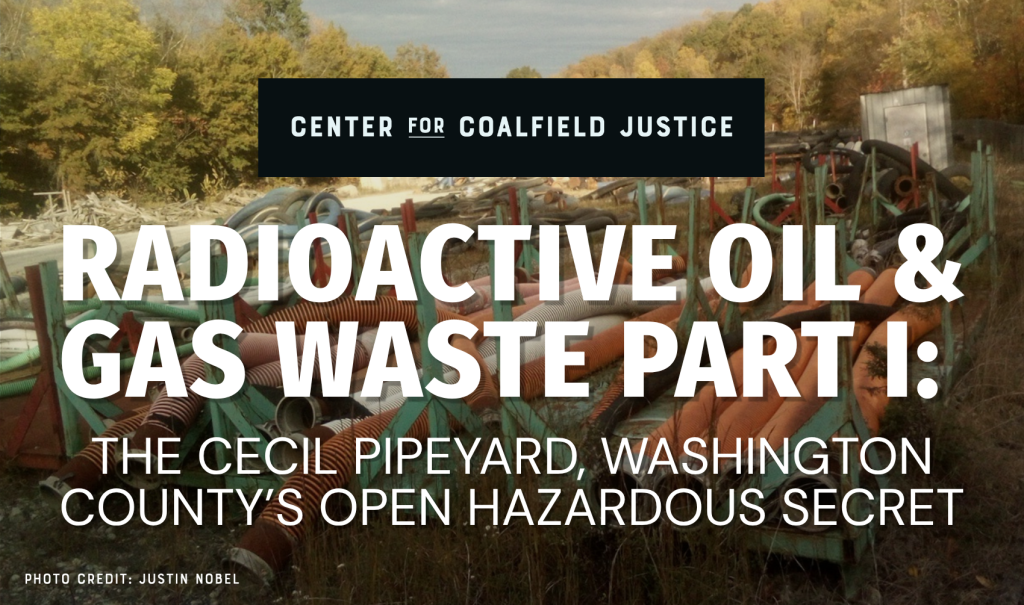
The oil and gas industry in our region is plagued by a very dangerous, open secret: the waste it produces is highly radioactive. Despite what industry representatives, members of Congress, and regulators say, every facet of the waste stream of fracking in PA is riddled with radioactive byproducts that are mishandled and sometimes simply left to rot in our communities.
There is no more obvious example than the Cecil Pipeyard. This blog serves as a companion to the powerful investigative report by Justin Nobel detailing the discovery of dangerous radioactivity in a Washington County community and the long history of negligent mismanagement by both industry and regulators.
A Publicly Accessible Hazardous Waste Pit
The Cecil Yard is an open-air, partially fenced Waste Processing Facility in Cecil Township, Washington County. Over the past few decades, the facility has been used for the short- and long-term storage of various types of waste. But then the site came under the operation of 5D Field Services, and in May 2025, it was approved by the Pennsylvania Department of Environmental Protection (“DEP”) to accept and temporarily store radioactive oil & gas waste. This permit allowed for the acceptance of 1,500 tons of waste per day, with a seven-acre portion of the facility becoming the site where huge piles of leftover pipes from oil & gas operations now sit.
Concerned adjacent residents have questioned how ‘temporary’ the pipe storage really is, as many stacks have been unmoved for upwards of a year. These community concerns are compounded by the fact that this facility is located along Miller’s Run just upstream of Cecil Park and directly borders a half-mile section of the popular Westland Branch of the Montour Trail.
On that section of the Montour Trail, Nobel easily entered the pipeyard through multiple holes in the fence and found no signage regarding trespassing or the radioactive nature of the waste. Nobel was able to return to the site multiple times and conduct independent testing of pipes that sit mere dozens of feet from people’s backyards. In collaboration with local and regional organizers, a former scientist with the US Dept of Energy, and a nuclear engineer with the University of Texas, the team collected samples from these pipes and had them analyzed for radioactivity. The results were highly concerning.
On one pipe, the team found levels of radium-226, a dangerous cancer-causing compound that is ubiquitous with fracking operations, 622 times higher than applicable limits. On one site, a Geiger counter showed 4.88 milliroentgens per hour, nearly 1,000 times the location’s background radiation levels!
According to industry guidelines on radioactivity and workplace safety, readings more than double the background level should prompt immediate cleanup, removal, and disposal of the emitting waste. This radiation is coming from a pipe large enough for a child to crawl through, on a site exposed to the elements with improper fencing and no warning signage, right next to a popular trail and community park. How are local children and community members supposed to know how dangerous this facility is? Why is this highly radioactive waste allowed to sit in places where it is so close and accessible to the public?
What Makes Radium Dangerous?
Unfortunately, radioactive waste from oil & gas activities is routinely treated as if it is much less dangerous than it is. It’s an approach that is firmly in opposition to science. Radium-226 is a highly stable, very radioactive substance. Exposure to it poses dramatic short- and long-term environmental and human health impacts. Radium-226 is highly carcinogenic and is known as a ‘metallic bioaccumulator’. This means that in addition to the standard cancer-causing, organ-attacking effects that acute exposure to the radiation can cause, it is the type of heavy metal that the human body misidentifies as something that it wants to keep, so it stores it in our bones. Your body essentially thinks the radium is a helpful metal like calcium, so it stores it with the other metals in your skeleton, leading to bone and blood cancers.
Furthermore, Radium-226 has a half-life of 1600 years, meaning it will persist in the environment and spread from its source nearly indefinitely. Its bioaccumulation potential is not restricted to humans, as it is commonly found in plant life, fish, game, and livestock that are exposed to it. In combination, this means that not only are those who live right next to or recreate next to the Cecil Yard risking dangerous exposure, but those who drink water fed by Miller’s Run, eat fish living within or downstream of it, or consume livestock that drink from it are all at risk of slowly accumulating Radium in their body over a lifetime of exposure.
In response to this information, there are two main questions: Why are these pipes, and oil & gas waste generally, so radioactive? Why isn’t this waste being treated as seriously as it should be? Unfortunately, the answer to both of them is that the current status quo directly benefits the fracking industry.
Why Is Oil and Gas Waste So Radioactive?
Fracking brings up a lot more than just gas and oil to the surface. The Marcellus Shale formation, where the majority of fracked gas in PA comes from, contains and is surrounded by very high amounts of naturally occurring radioactive materials. Due to the high pressure and physical and chemical fracturing of the rock that occur during extraction, many of those materials are disrupted and brought to the surface through wastewater, solid waste, and the extracted gases themselves. This type of waste is called Technologically Enhanced Naturally Occurring Radioactive Material (“TENORM”). TENORM is an inseparable consequence of fracking operations in our region. Thus, the mere ability to identify specific radioactive materials allows you to tie their presence to fracking operations directly. Both the Marcellus and its surrounding layers have very high levels of Radium, so it’s no surprise that pipes transporting millions of tons of this waste would be contaminated by it.
So if we know that fracking creates enormous amounts of radioactive waste, and we know that a large pile of it is sitting next to a popular trail in the middle of Cecil, why aren’t state regulators rushing to clean it up?
“The Industry’s Worst Kept Secret:” Why Regulators Continue to Ignore Radioactive Fracking Waste
After Nobel and his team conducted sampling and testing of the pipeyard, they sent several letters describing their experience and results to multiple applicable state and federal agencies, the state radiation complaint line, and Gov. Shapiro’s office. Put plainly, Nobel said he felt, “Given the unusual and extraordinary contamination present at this site…I felt the need to, before publishing anything in the media, notify appropriate agencies and officials.” In early May of this year, a few weeks after Nobel sent out this letter, the State Bureau of Waste Management conducted a site visit in Cecil, brought no Geiger counter, found nothing in violation, and closed the complaint. Over the next few weeks, Nobel would receive a few other responses from different agencies, all saying some form of ‘no action needed’ or ‘no additional information available’ concerning the site. DEP also told WPXI that “because its inspection found no public health threat, it does not plan to collect soil samples at this time.”
In the face of such damning evidence about something as serious as radioactivity in a location as exposed as the Cecil Yard, how can our state agencies simply pretend that this isn’t a problem? How and why do they keep pretending that these pipes aren’t radioactive? The answer lies in how oil & gas waste is regulated in PA, with industry and regulators working together to prevent it from being properly designated. If the industry and regulators were forced to address the radioactive nature of oil and gas waste, the industry, as it is currently structured, could collapse.
Oil & gas waste is regulated as ‘residual waste’ in Pennsylvania, a general term that describes all nonhazardous industrial, commercial, and agricultural waste. In practice, this allows operators who create residual waste to have access to DEP’s ‘beneficial use’ program. This is a program created by DEP to incentivize operators to recycle their waste for other beneficial uses, or to turn the waste into a viable product for their own use or as one they sell commercially. In theory, ‘co-products’ encourage operators not to simply fill landfills with endless waste, but to examine if there are feasible opportunities to reuse it. Many different types of fracking waste are used under this program, saving operators on waste management costs while giving them opportunities to repackage and sell their waste rather than dispose of it. If a waste product is hazardous or even radioactive, it cannot be designated as residual waste. The fracking industry wants, in part, to keep its waste designated as residual so it can retain access to this program.
But this is far from the only difference between hazardous waste and residual waste. In comparison, hazardous waste has much more stringent permitting, tracking, transportation, and storage requirements, as well as restrictions on the types of facilities that can accept and process it. Put simply, hazardous waste is far more logistically difficult and costly to handle, transport, and dispose of than residual waste. If you want to learn more about the oil & gas industry’s current disastrous method for disposing of its liquid waste, you can read our previous blog on injection wells.
The fracking industry in PA has generated billions of tons of waste since its explosion in 2008. Yet there are only a handful of waste facilities in our region that can accept, handle, store, and treat radioactive hazardous waste. This contradiction is at the heart of why DEP and our legislators refuse to definitively address the radioactivity of this waste — to the point of creating a public health and environmental risk. Doing so would mean it can no longer be designated as residual waste. The entire hazardous waste sector of our region has nowhere near the capacity to handle all of this fracking waste if it were correctly designated as hazardous. In turn, the whole industry would either need to dramatically and fundamentally restructure and downsize, or—more likely—collapse under the financial strain of trying to do so. As such, there has been a profound, coordinated effort by industry to downplay, dismiss, lie, misrepresent, and lobby our state government to maintain the status quo regarding this waste designation. In effect, this has created the industry’s worst-kept secret, where just about everyone knows how radioactive the material is, but no one in power can take meaningful action to fix it without collapsing a lynchpin of the state’s economy.
In examining just how deep this cover-up goes and just how much our government bends to the industry’s needs, Part II of this blog series will examine how state regulators do more than just put on blinders to the dangerous radioactive nature of this waste, as they did in Cecil. We’ll discuss DEP’s Report on Radioactivity of Landfill Leachate and how the Shapiro Administration is actively creating cover for the fracking industry, while putting the health and safety of our communities and our environment at risk.
There is also a motocross track where adults and children are riding dirt bikes only 700 ft away. There is a slag pile even closer. There is no barrier between the hazardous waste yard and a clearly visible path from the waste yard to the track.
There is no oversight or frankly concern from the township or state agencies. There is no accountability on part of the owners/operators of the site they profit from at the expense of the community and residents that live nearby.
Great article and I think we as a community as a nation must address this issue. We need like minds and scientists to go shoulder to shoulder with us. Together we are strong. But individuals small groups are labeled as fear mongers, or ill informed about regulations, acceptable levels and testing required by law.
We must reach out to like minded local, state and federal employees and elected to make a change in what is happening to us in Cecil Township. From both short term and long term affects of these dangerous practices.
Thank you so much for this most informative blog.